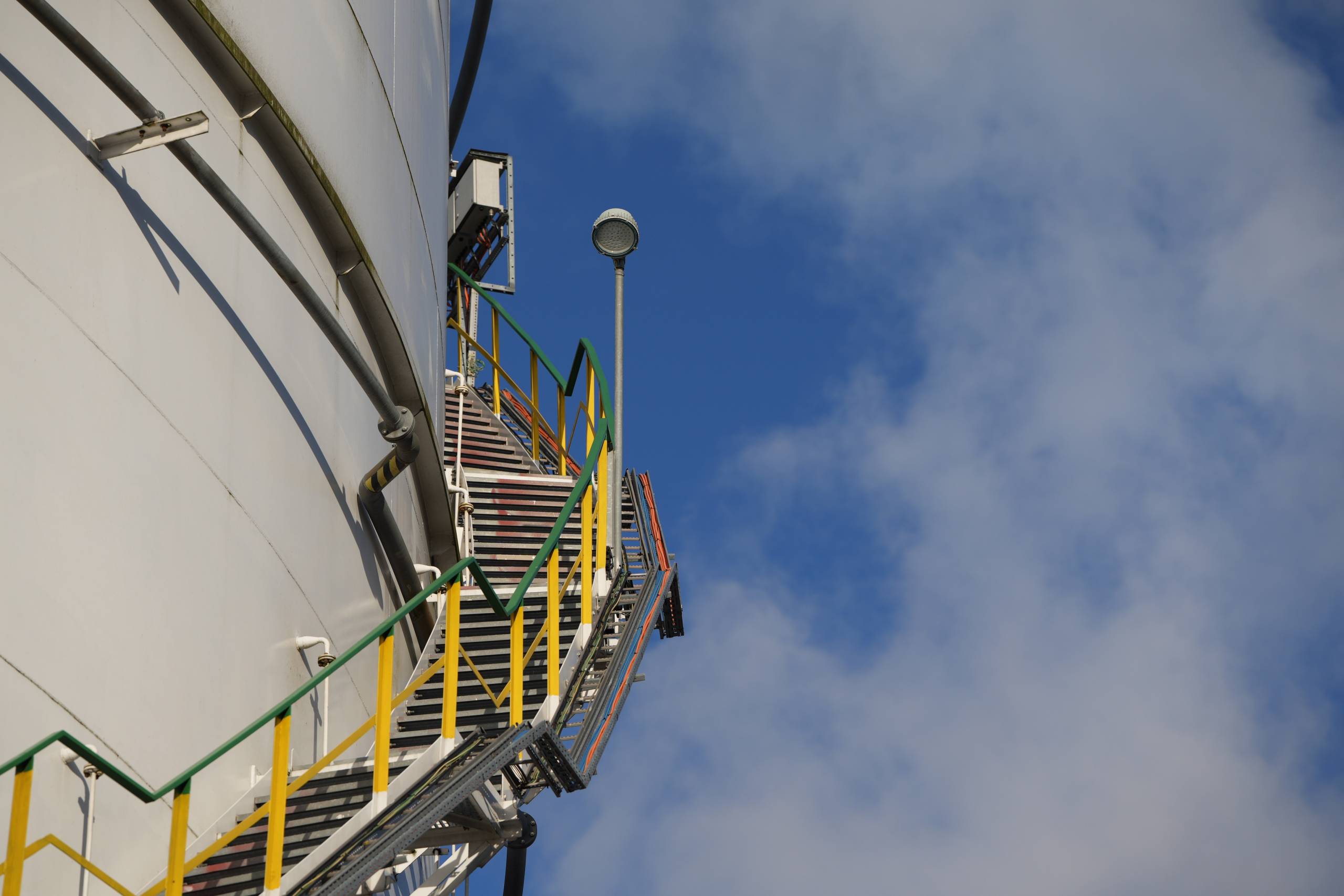
We care for the environment – building a responsible tomorrow

Our primary environmental commitment is to increase energy and operational efficiency, reduce CO₂ emissions, and transition to a low-carbon product portfolio in order to ensure climate-neutral operations.

2030

30% CO₂ reduction

2040

~70% CO₂ reduction

2050

climate neutrality

Water and Wastewater

At the Klaipėda Liquid Energy Products Terminal, we operate a unique wastewater treatment system designed to collect and treat wastewater generated during our operations. The biological wastewater treatment facilities operate on the biosorption principle, using activated carbon and microorganisms. This unique technology enables very high treatment efficiency—up to 99.9%. We monitor discharged wastewater and its impact on surface water quality by tracking the condition of the Curonian Lagoon, ensuring responsible management of our operational impact.

During the warm season, water from the Curonian Lagoon is used in the regasification process of the FSRU Independence and is then returned. The returned water is chemically unchanged—only slightly cooler than the lagoon temperature. During the cold season, the unit operates in a closed-loop mode, so no water is taken from the environment.
Air quality

We continuously monitor air quality by carrying out monitoring of pollutants emitted from stationary air pollution sources and their impact on ambient air quality. The monitoring is conducted in accordance with an approved monitoring programme coordinated with environmental authorities, ensuring transparent and responsible control of our operations.

Applied Technologies

Handling operations of liquid energy products at the Klaipėda Terminal are carried out in accordance with the Integrated Pollution Prevention and Control (IPPC) permit issued by the Lithuanian Environmental Protection Agency, while operations at the Subačius Terminal are carried out under a Pollution Permit (PP). These permits define environmental protection measures applied by the Company to reduce the release of pollutants and odours into the environment.

The following technological installations for reducing air pollution are in place at the Klaipėda Terminal:

  • VOC recovery unit;

  • VOC incineration unit;

  • air pollutant treatment unit operating on the basis of activated carbon.

These technological installations capture more than 98% of emitted vapours.

In addition, since 2018, an Environmental Protection Measures Plan has been implemented at the Klaipėda Liquid Energy Products Terminal, providing for technological measures and a commitment to continue sustainable operations and ensure the highest environmental protection standards.

Air Quality Monitoring

We carry out ambient air quality monitoring to assess concentrations of volatile organic compounds (VOCs) – benzene, toluene, ethylbenzene, m/p-xylene, and o-xylene – outside the Klaipėda Terminal territory. Monitoring is conducted using passive samplers at two monitoring locations on a quarterly basis. The duration of a single sampling period is two weeks. Ambient air quality monitoring using passive samplers is an effective and reliable method that enables an objective assessment of the impact of VOCs on ambient air quality.

When assessing environmental impact, it is important to consider that the dispersion of pollutants in the environment is influenced by the following factors:

  • the height of pollution sources and the concentration of pollutants emitted from them;

  • meteorological conditions, including wind direction, speed, and turbulence, as well as air temperature and humidity;

  • terrain characteristics and building heights.

It is important to note that the smell of petroleum products becomes perceptible to humans when the concentration of VOCs in the air reaches approximately 0.3 mg/m³.

Air quality real-time monitoring

In order to monitor and manage the potential environmental impact of the Klaipėda Liquid Energy Products Terminal, KN Energies has installed sensors around the perimeter of the terminal territory for self-monitoring purposes. These sensors continuously measure concentrations of volatile organic compounds (VOCs) in the ambient air.

Legislation defines that the half-hour limit value for VOCs in the working environment (within the terminal territory) is 200 mg/m³, while in the residential environment (outside the terminal territory) it is 5 mg/m³. Although the sensors are installed within the terminal territory, the measured VOC values are compared against the residential environment limit value of 5 mg/m³. Sensor data are updated every half hour. In the ambient air monitoring scheme, several VOC sensors are highlighted in coral colour, which may indicate the impact on ambient air quality from another oil and chemical products handling terminal operating in the vicinity of terminal.

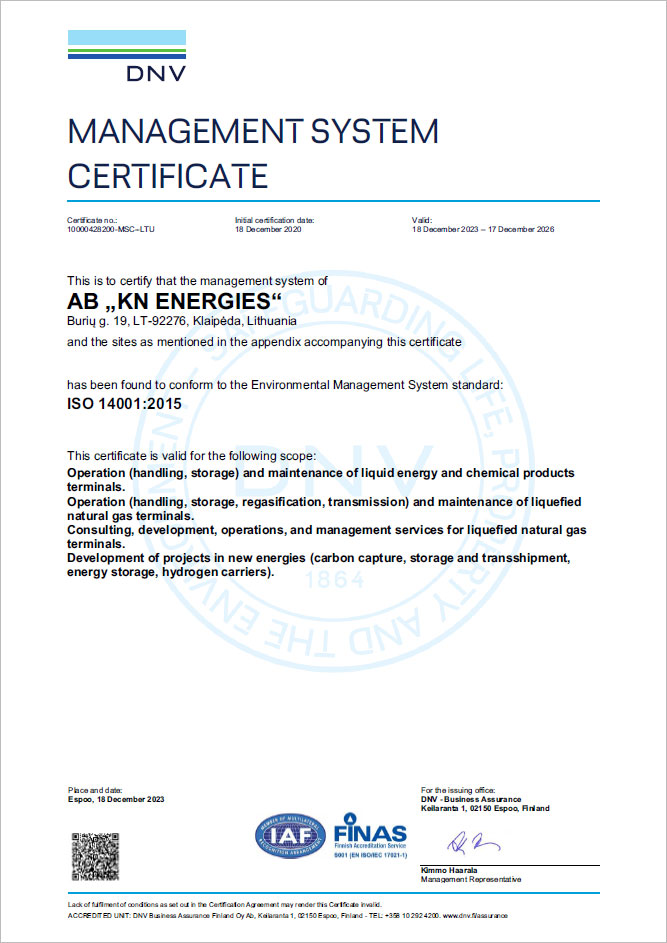
ISO 14001:2015

KN Energies environmental management system complies with the ISO 14001:2015 standard. The Company ensures maximum safety of the terminals it operates and implements solutions that meet the highest standards. In its operations, the Company uses modern production technologies and continuously implements technical measures aimed at reducing emissions, as well as carries out proper and regular maintenance and monitoring.

Contact us if you have any questions

The well-being of local residents is very important to us, therefore we are always ready to provide relevant information about ongoing handling operations and to respond promptly to received reports. You are welcome to contact the Company by phone at any time of day.

Call Us Call Us